


Praying with Gregorian Chant, Part IV: Moods of the 8 Church Modes

Updated: Dec 10, 2025
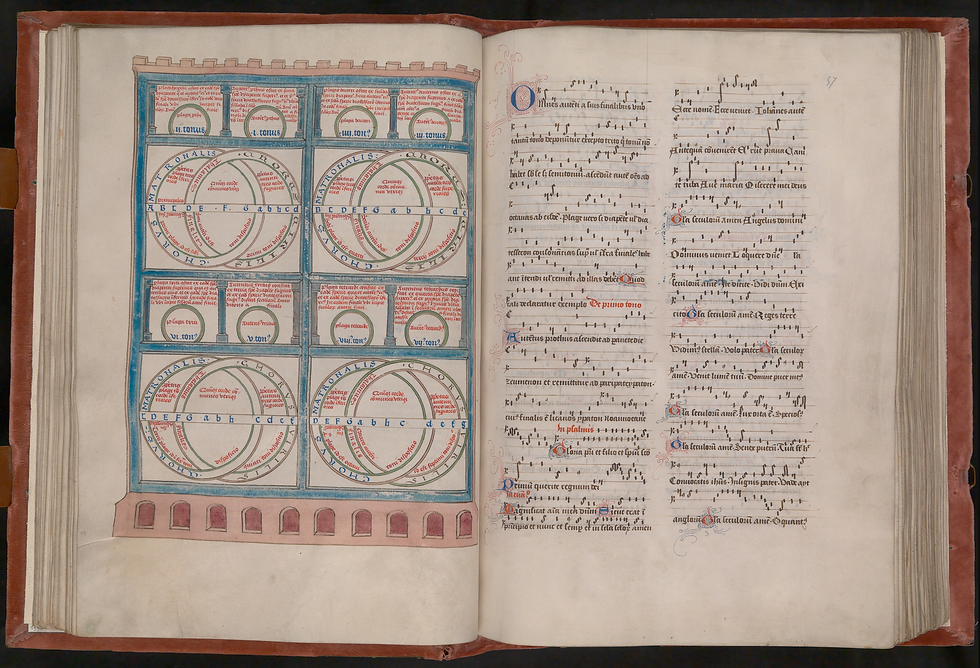
Diagram of modal theory (early 16th c.), Ghent, Rijkuniversiteit, Centrale Biliotheek, MS 70, folios 56v - 57r
OUTLINE
I. Boethius, and the power of music
II. A modal framework
a. Terminology: solfège and scales
b. Finals in Gregorian chant
c. Sounds of RE, MI, FA, and SOL as finals
III. Musical examples
IV. Odd vs. Even-numbered modes (Authentic vs. Plagal)
V. Characteristic melodic formulas
VI. Moods of the eight modes
VII. "Final" notes
a. Modal ambiguity and modal shifts
b. Transposition
c. Hierarchical scale degrees
d. Conformity (or lack thereof) to modal theory
e. Certain genres of chant gravitate towards particular modes
f. "Englished" psalm tones
VII. Modes and personality types
Hello, dear reader! As the adage goes, "long time, no see." Over a year ago, I undertook the writing of a blog article devoted to praying with Gregorian chant. One of my favorite group activities to lead is what I call a Musical Lectio Divina, and it is a subject about which I am deeply passionate. I expected the writing to wrap up quickly. However, as I progressed, it became evident that a whole series was in order. And after turning out Part III nine months ago, two things happened: 1) I discovered the music of Hildegard von Bingen and went down a huge rabbit hole, and 2) I was confronted by the overwhelming task of conveying genuinely helpful content concening the modes, without devolving into complicated technicalities.
Writing about the modes feels, at least to me, almost tantamount to writing about the Blessed Trinity. It is virtually impossible to convey any real substance on the subject without also unwittingly promulgating heresy. In the Online Chant Course - Level I, I do not even touch upon the modes until my students have spent a solid three weeks first experiencing them. Compounding the issue, the modern-day listener does not have the highly developed skills of memory that medieval musicians possessed, nor the heightened awareness of sensory experiences that were a normal part of medieval life.
Anyhow, the challenges have been astronomical. Thank you for your patience with me. A lot of blood, sweat, and tears went into this one. I hope that you will agree with me that, in the end, it was all worth it.
"The association of music with man is a natural one; music can, moreover, both establish and destroy morality."
As we prepare to embark upon our journey, allow me introduce you to someone. Boethius (c. 480 – 524) was a Roman senator, philosopher, historian, and writer. He was also a Christian and a martyr, and in 1883, he was confirmed a Catholic saint. (His feast day is October 23.) He also translated a large body of the writings of the ancient Greek philosophers into Latin. Centuries after his death, when early medieval theorists became obsessed with Greek thought and culture, but did not know how to read the language, his texts became influential to the development of modal theory.

Boethius teaching his students,1385 MS Hunter 374 (V.1.11), folio 4r
In De institutione musica (Five Books on Music), Boethius draws on the thought of Plato, Aristotle, and Pythagoras, addressing the power of consonance and dissonance in music, and demonstrating the mathematical ratios which form the basis of pure intervals. The universe and everything in it was thought to be created, quite literally, in a perfect harmony. that was governed by simple, precise ratios. An octave, for instance, is composed from a wave length ratio of 1:2, a perfect fifth from a wave length ratio of 2:3, and a perfect fourth from a wave length ratio of 3:4. (One shudders to think what he would have said about today's equal temperament tuning!)
He explains that the modes first received their names from the peoples who shared their character.
"For similarity is pleasing, but dissimilarity is hateful and opposed. From this principle, too, do changes of character come about and this to no small degree. The frivolous spirit, for example, either himself delights in more frivolous modes or on often hearing the same is quickly softened and weakened. Again, a harsher spirit either enjoys more exciting modes or is rendered harsher thereby. It is for this reason, too, that musical modes were represented with the name of the peoples, as the Lydian mode and the Phrygian. For in whichever mode the people rejoice, that mode itself is called by the same name.”
In the same chapter, Boethius proceeds to record several events from ancient Greece during which the playing of music altered emotional states, thus dissuading various persons from committing actions of considerable harm. In fact, so strong was their belief that music forms morality, that in Lacedemonia, when a certain Timothy the Milesian "added a string" to the musical scale, they threw him out of the city! For the Spartans believed that "by rendering the music complex, he brought it about that the souls of the youths, who had been entrusted to him to educate, were hindered from the moderation that characterizes virtue."
This train of thought, though perhaps laughable in its severity today, throws into stark relief a current trending perspective that a person's experience of music is merely subjective, influenced entirely by formative experiences. I am of the conviction that the truth lies somewhere in the middle of these two extremes.
A modal framework
When learning how to sing Gregorian chant, a musician is immediately confronted by numerous obstacles. The notation and movable DO system are the most obvious concerns. A certain comfort with the Latin language is also needed, and of course, a sense of free meter.
In the face of so many challenges, one aspect tends to take a back seat: the eight modes. This facet, however, is intensely critical, because one cannot render a chant musically if one does not intuit why its melody behaves in the manner it does. Many have had the experience of perfectly sight reading a chant, yet still arriving at the end and wondering whether they actually sang it correctly. It is because they have not yet developed a modal sense for the chant.
Today, we will begin our examination from something that is well established for the contemporary musician: the Major Scale. The major scale can be played or sung starting from any key or pitch. The simplest form is the C major scale, C - D - E - F - G - A - B - C. From this framework, we can deduce that the major scale consists of a certain sequence of intervals: whole step - whole step - half step/semitone - whole step - whole step - whole step - half step/semitone. The half steps/semitones occur between the 3rd and 4th scale degrees (E and F), and the seventh and first scale degrees (B and C).
Even if I decide to produce the major scale starting from a different key or pitch than C, I will retain this same sequence of intervals:
W - W - 1/2 - W - W - W - 1/2
Since Gregorian chant is sung in a movable DO system — meaning one can start singing a chant from any pitch one wishes, as long as the same sequence of intervals is preserved — the system of movable DO solfège will be implemented in this article. Hence,
W - W - 1/2 - W - W - W - 1/2
becomes
DO - RE - MI - FA - SOL - TI - DO - (etc.)
The half steps/semitones occur between MI-FA and TI-DO.
Now, the fundamental, or tonic, or final, or resting pitch of the major scale is DO. When a person plays or sings a piece of music in Major, there is a sense of arriving back at "home" when landing on DO.
The Minor Scale is closely related. It follows the same sequence as the major scale, but starts from a different scale degree: LA.
W - 1/2 - W - W - 1/2 - W - W - W
LA - TI - DO - RE - MI - FA - SOL - LA - (etc.)
A musician playing or singing a piece of music in Minor will experience a sense of arriving back at "home" when landing on LA.
Finals in Gregorian Chant
In Gregorian chant, there is no Major or Minor. (For our purposes, we are going to ignore the one exception, Mode V with the B flat, which is basically the same as Major.) The fundamental resting pitches are totally different. In Gregorian chant, the home pitches are RE, MI, FA, and SOL. If you would like to hear these put into the full context of the octave-based scale, you can listen to them in this neat little blog article I came across while researching musical examples for this one. In truth, it is highly doubtful that medieval musicians ever played such scales, particularly since they solmized in terms of hexachords rather than octaves, but again, we'll put this fact to the side for our purposes today.

The sounds of RE, MI, FA, and SOL as finals
It might at the outset seem antithetical to include secular pieces in an article which is part of a series devoted to Praying with Gregorian Chant. I think, though, that some non-chant examples will be helpful in driving home these critical concepts. Gregorian chant already has an unfamiliar sound due to its free meter and lack of harmonization, and this can make it difficult for the foreigner, sojourning in the strange land of chant, to identify crucial principles. Even for the native dweller, it takes a good deal of work to get to the heart of this subject!
My criteria for the examples which follow are strict:
the melody by itself must clearly belong to the demonstrated mode
should be "hummable"
concludes on the same pitch as its fundamental/tonic/home pitch
must be Dorian, Phrygian, Lydian, or Mixolydian (based upon RE, MI, FA, or SOL)
for obvious reasons, the lyrics must be appropriate to this reader base
A little warning...
In the process of selecting examples, I also realized they would be made clearer if rendered in chant notation. I'm bracing you, because you are about to discover — gasp! — among other representatives, a Beatles song in square notes.
Truth be told, though, there is a precedent. Chant notation was the only musical notation in existence in the western world for quite some time, and historically, there is a significant body of secular music which has survived alongside the Gregorian repertory, using the exact same notation. You will also notice a Gregorian modal assignment for each example, to further illustrate the modality of these pieces.
Ready? Heeeeeeeeere we go!
"For nothing is more proper to humanity than to be relaxed by sweet modes and to be made tense by the opposite." ~ Boethius
Modes I & II: RE modes (or Dorian mode)
PICARDY

KINGSFOLD

GREENSLEEVES, original Dorian mode
YouTube listening link
Have you ever wondered why there are two different variations for this melody? The version with the natural seventh and first scale degrees, TI and DO, (the version here) are characteristic of the Dorian mode. These pitches were later adapted to TE and DI to conform to the more familiar, modern-day Minor scale.

Scarborough Fair, traditional English ballad
YouTube listening link

Characteristics
Minor thirds, and their associated somber sound, occur both above and below the final (RE-FA and RE-TI).
Descriptors sometimes used for the RE modes
uncertain
sophisticated
dark with a hint of light
serious
triumphant
sturdy
manly
melancholy & hope
Representative chants
Ave Maria, antiphon for Lauds of the Annunciation, traditional Roman rite
YouTube listening link

Sanctus from Missa XI, Orbis Factor
YouTube listening link

Now it's your turn. How would you describe the overall feeling of the RE modes?
Modes III & IV: MI modes (or Phrygian mode)
PASSION CHORALE

A Tu Vera, Juan Solano & Rafael De Leon, as performed by Lola Flores
YouTube listening link
In addition to the fundamental/final of MI, there is also a marked presence of TI in this song, which further underlines the emphasis on the lower degree of the half step/semitone within the scale.

Lothlorien theme, Howard Shore, from The Lord of the Rings
YouTube listening link
By leaning into the upper degree of the half step/semitone in "Ela i cá Nenya sina", the piece exaggerates the feeling of tension between the two scale degrees. Apologies for all the clef changes; this piece has a very wide range, as well as a few key changes, and was eminently challenging to render in this format! Just follow the custos (guide note) before each clef or key change...

Characteristics
Complex interaction at the half step/semitone (MI-FA), with the lower degree being drawn towards the upper. The MI can sometimes be misunderstood as the leading tone to FA, and as a result, these modes can easily mutate to a fundamental of FA.
Descriptors sometimes used for the MI modes
exotic
lively
intense
dark
mystic
haunting
lamenting
weight & "gravitas"
Representative chants
Mode III: Pange lingua gloriosi, hymn for Holy Thursday (verse 1)
YouTube listening link

Mode IV: Crucem tuam, antiphon for Good Friday
YouTube listening link

What do you notice about the distinctive sound of the MI modes? What descriptors would you use?
Modes V & VI: FA modes (or Lydian mode)
Maria! Leonard Bernstein, from West Side Story
YouTube listening link (begins at 0:42)
This song is famous for its use of the tritone, or FA-TI interval, an interval which is avoided in Gregorian chant, typically by lowering the seventh scale degree by one half step/semitone, to FA-TE.

Lydia, Gabriel Fauré
YouTube listening link
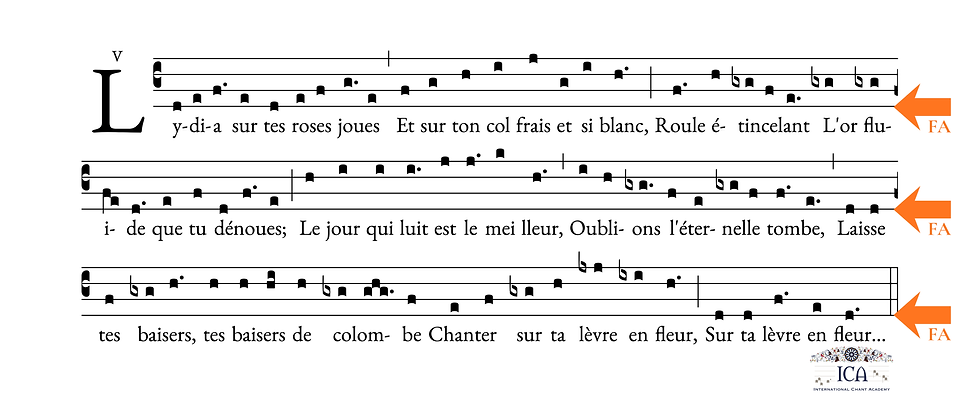
BATCHELLOR (ONSLOW)
YouTube listening link

Characteristics
Strong attraction to the final, FA. Tritone (FA-TI interval created by 3 sequential whole steps, FA-SOL-LA-TI) naturally occurs with frequency, giving it an exceptionally bright sound. In medieval times, the tritone was felt to be particularly dissonant, and was avoided through the use of the B flat (TE).
Descriptors sometimes used for the FA modes
bright
ethereal
uplifting
happy
dreamy
airy
wonder
mysterious
futuristic
Representative chants
Mode V: Christus factus est, gradual for Holy Week (Palm Sunday and Good Friday in modern Roman rite, Holy Thursday in traditional Roman rite)
YouTube listening link

Mode VI: Ave verum corpus, ad libitum chant
YouTube listening link

How would you describe the spirit of the FA modes?
Modes VII & VIII: SOL modes (or Mixolydian mode)
She moved through the fair, Irish/Scottish ballad
YouTube listening link

Old Joe Clark, Appalachian folk song
YouTube listening link
The melody sounds Dorian (RE mode) until the descent in the second half of the verse completes the context of SOL.

Sweet Home Alabama, Lynyrd Skynyrd
YouTube listening link
This song, with its limited use of scale degrees, can be classified both as Ionian/Major and as Mixolydian.

Norwegian Wood, the Beatles
YouTube listening link
This piece moves back and forth between Mixolydian (SOL) and Dorian (RE); the Dorian section occurs by the prolonged presence of the ME (MI flat): "She asked me to stay....there wasn't a chair," and then reverts back to Mixolydian.

Characteristics
Compositionally very stable. No leading tone.
Descriptors sometimes used for the SOL modes
joyful
laid back
confident
grounded
powerful
positive
searching
sweet-yet-serious
Representative chants
Mode VII: Hosanna filio David, antiphon for Palm Sunday
YouTube listening link

Mode VIII: Veni Creator Spiritus, hymn to the Holy Spirit (verse 1)
YouTube listening link

What do you hear? What sort of mood does the SOL modes invoke?
The mission of the International Chant Academy is to keep the beauty and meaningfulness of Gregorian Chant and Early Sacred Music alive and relevant. We foster understanding of these art forms, and teach the musical and vocal skills necessary to excellent performance.
Visit our website.
Odd vs. Even numbers (Authentic vs. Plagal modes)
You may be wondering now,"Okay, I get that there are different sounds and feelings caused by the four finals of RE, MI, FA, and SOL, but why do each of the finals have two modes connected to it, instead of just one?"

In most discussions, this is precisely the point at which things start to get very technical. The odd modes and the even modes are, by definition, distinguished from each other by their ranges with respect to the final (i.e. the ambitus). Theorists have very precise criteria when assigning a modal number. (For a detailed treatment, one may visit Willi Apel’s Gregorian Chant, Chapter Three.)
For our purposes, let us accept the modal assignments already given, and focus instead on some of the underpinning reasons for making such hair-splitting considerations. Fortunately, underneath all the scholarly evidence, there are supremely practical reasons.
We need to travel back in time about 1300 years, to a period during which musical notation was not yet capable of demonstrating precise intervals through visual symbols. Now, according to musicologist Kenneth Levy, there is an estimated 75-80 hours of free-composed music in the Gregorian repertory. Along with committing to memory the full texts of the entire Psalter, the entire body of liturgical chant had to be completely memorized by its singers! Imagine trying to commit this much music to memory, and annually reproducing it with accuracy.
Cantors needed systems to assist them in this task of recalling the chants from year to year. Anna Maria Busse Berger relates in her book, Medieval Music and the Art of Memory, that in the eighth century, Carolingian theorists started to catalogue the body of Gregorian chant (which for the most part was already existing and in use) into eight categories: one category per psalm tone.
Chants were collected by these categories into books called tonaries. Tonaries assisted cantors to 1) identify similarities among diverse chants, making it easier to retrieve them from memory, 2) match an appropriate reciting tone to the chant antiphon, and 3) discern which psalm tone termination will most easily transition the singers back into singing the antiphon upon conclusion of the psalm.
The reciting tone
Let us focus upon the second reason: pairing a chant with an appropriate reciting tone. Most antiphons do not exist in a vacuum. Rather, they accompany the singing of a psalm or canticle. In the Mass, the psalmody may be just a few verses to extend the music to cover the length of the liturgical action (i.e. the introit verses and communion verses; offertory verses, on contrast were highly elaborate, soloist chants — see blog article). In the Office, of which the fundamental purpose is the daily praying of the Psalms, the psalm tones constitute the main body of the music.
Now, the glue that holds a psalm tone together is an elastic reciting tone which accommodates the singing of verses of varying lengths. Long verses have many syllables of text which align with the reciting tone, whereas shorter verses have relatively few syllables on the reciting tone.
For the purpose of illustration, here is the Magnificat, the Gospel canticle for daily Vespers, sung to the psalm tone for Mode VIII. Can you hear the strong presence of the reciting tone?
The bottom line: most of a psalm or canticle is sung on the reciting tone — i.e., on a single pitch. And when a monastic community spends six hours together on a daily basis singing the Hours of the Divine Office, determining a comfortable pitch for a reciting tone is paramount. (The issue is somewhat related to the modern-day organist's conundrum about how high or low a key a particular hymn should be played.)
A chant with a more extensive range (or ambitus) above its final (authentic range) is paired with a similarly higher reciting tone, while a chant with a more limited ambitus above the final (plagal range) is paired with a reciting tone much closer to the final.
If you would like to see this principle at work "in the wild", below you will find the Magnificat antiphons for First and Second Vespers of Corpus Christi, O quam suavis (Mode VI) and O sacrum convivium (Mode V). Modes V and VI share the same final, FA. What relegates these two antiphons to their respective modes is the ambitus of the melody with respect to its final. The highest pitch of O quam suavis is one sixth above its final. The highest pitch of O sacrum convivium is a full octave + 1 whole step/whole tone above its final.
The designated reciting tone for Mode VI is a major third above the final.

The designated reciting tone for Mode V is a fifth above the final.

Do you see how the reciting tone in both examples is fitted to the range of the antiphon in relation to its final?
Conversely, once the reciting tone has been assigned, it is a relatively simple process to determine an appropriate starting pitch for the antiphon. To this day, the standard rule of thumb for determining the starting pitch of a chant is to consider the reciting tone of its mode, and to match that reciting tone to a pitch which can be comfortably sustained for an extended period of time: usually an A, although I personally tend to prefer a G. I should mention here, however, that there is much debate about the proper singing range of chant as well. Solesmes Abbey is said to have raised the performance standard by as much as a fourth!
Characteristic melodic formulas
In a musical epoch which transmitted chants to future generations by pure memorization, cantors invented all sorts of useful devices to assist in its dissemination. The modes were distinguished from each other not only by final and ambitus, but also by characteristic melody phrases. A chart such as the one below played a critical role in developing a sense of the modes. Budding cantors would learn each of these melodies, often with an appropriate scriptural text referencing the number of the mode. (For reference, these are the "noeanne" which Anna Maria Busse Berger writes about in her book, Medieval Music and the Art of Memory.)

chart based upon the Latin intonation formulas from Reichenau (Bamberg, Staatsbibliothek, Ms. lit. 5; Bailey, Commemoratio brevis, 81-90
Within each phrase are modal microcosms. Repeated pitches, whole steps, half steps/semitones, minor thirds, major thirds, fourths, and fifths — each lend their own color and feeling to the developing lines.
Moods of the 8 Church Modes
And now, finally, we arrive at the crux of this article: the moods of the 8 church modes. All of these different principles contribute to a distinctive modal ethos, or modal sentiment, for each of the eight modes. As you read at the beginning of this article, musicians have ascribed different sentiments to each of the modes as early as ancient Greece. The most famous descriptions of the Gregorian modes come to us from the pen of Abbot Poisson in the eighteenth century.
Mode I: gravis ~ peace, tranquility, equilibrium
Mode II: tristis ~ gravity, somber
Mode III: mysticus ~ humble dignity
Mode IV: harmonicus ~ that is, well ordered, "the mode without an end"
Mode V: laetus ~ trumpeting, firmness
Mode VI: devotus ~ simple joy, confidence, filial piety
Mode VII: angelicus ~ exaltation, triumphant joy, enthusiasm
Mode VIII: perfectus ~ certitude, stability, affirmation
Many other writers have shared their experiences of the Gregorian modes. Here is Father Columba Kelly, OSB's interpretation:
Mode I: solemnity
Mode II: reverence and awe
Mode III: intense feeling, either sadness or joy
Mode IV: reflective, meditative
Mode V: joyful, happy
Mode VI: calm, relaxed, contented
Mode VII: joyful, triumphant
Mode VIII: authoritative, a narrator’s voice
Father Kelly also encouraged his students to develop their own descriptions.
Ethos in action!
Thanks to Father Kelly, whom I believe first used this example, below is the communion chant, Comedite, which is proper to the 3rd Sunday of Ordinary Time, Cycle C, in the modern Roman Rite. The chant is classified as Mode VIII because of its final, SOL. However, upon closer inspection, this chant does not hold to the SOL fundamental throughout. Rather, each of its four lines gravitates toward a different scale degree. (This is not at all uncommon; many chants are modally ambiguous, shifting from mode to mode. It is yet another aspect of what makes this repertory so rich and deep...and also part of why it is so extremely difficult to write a blog article on the modes!!)
"Go, eat fat meats, and drink sweet wine,
and send portions to them that have not prepared for themselves:
because it is the holy day of the Lord, and be not sad:
for the joy of the Lord is our strength."
~ Nehemiah 8:10
Observe how closely the sentiment of each text line corresponds to its respective mode and ethos. Youtube listening link

A few "final" notes
Pun not intended, ha! But on a more serious "note" (the hits just keep on coming...), what has been provided in this article is just an introduction to some of the principles underlying the Gregorian modes. The subject is exceedingly complex, and there are many key issues deserving treatment which are beyond the scope of this already-very-long essay. Just a few outlying considerations:
Modal ambiguity and modal shifts. For ease today, the final of a chant has been assumed to be, more or less, identical to the fundamental, or resting/home pitch, of the piece. As we have seen above in Comedite, it isn't always that simple. The fundamental may or may not actually correspond directly to the final of the chant. In fact, a chant may fluctuate between multiple fundamentals (though never more than one fundamental at once, per the definition of the word). One of the most striking examples of a chant with conflicting fundamental and final is the offertory, Justitiae Domini. This offertory effectively functions as a Mode VI, FA chant, but abruptly modulates at the very end to MI. Even though it only arrives at MI at the very end, chants are always modally classified according to their final. So, the chant is relegated to Mode IV — a MI mode. YouTube listening link

Transposition. Not all chants actually conclude on RE, MI, FA, or SOL. Some finish on LA, TI, or DO. However, these degrees are not considered to constitute new modes, but rather, are notational transpositions of chants which belong to the original four fundamentals. I have tackled transposition briefly in my article on the chants of Hildegard von Bingen, Section IV: Modes, Psalm Tones, and Differentiae.
Hierarchical scale degrees. Each mode leans into certain scale degrees as structural pitches, with others serving in a more ornamental role. This hierarchy also helps to shape the sounds of the modes and of the chants. One of my first blog articles was an attempt to delve into this phenomenon (although I have learned a whole lot more since then). It is a concept which is extensively tackled in Dom Daniel Saulnier's book, The Gregorian Modes.
More ancient chants conform less well to the theory of the Gregorian Octoechos (eight mode system) than newer chants. Saulnier says that the chants of the Office belong to an older layer of Gregorian chant, and defy modal theory with much more consistency than the chants of the Mass.
Certain genres of chant gravitate towards particular modes. The Mass Tracts and Canticles, for instance, are only composed in Modes II and VIII. There is scholarship which suggests this is because they belong to the oldest layer of Gregorian chant, and that additional modes only later entered into the repertory, from other geographical regions. Typical modal designations for different genres of chant are included in Part III of this Praying with Gregorian Chant series.
"Englished" psalm tones. If you live in the world of vernacular chant, you have likely observed that psalm tones in English do not tend to have one single reciting tone, but have sometimes multiple reciting tones within the same verse. These new tones (e.g. Saint Meinrad Tones) have been devised to respond to the challenges of adapting to English the Gregorian tones, which are inextricably linked to Latin speech patterns. We spend quite a bit of time on the subject of Gregorian chant tones for use with vernacular language in the ICA's Psalmody course.
In conclusion...
Anyone who has spent time learning about Gregorian chant is well familiar with the experience of establishing certain principles, only to discover examples which utterly defy them. This is especially true when treating the modes. Please, do not be disheartened.
Many years ago, I taught music at a parochial grade school. The school was very much like most schools: the teachers were extremely devoted to their students, but some of them had trouble getting along with other teachers, and there was quite a bit of gossip behind closed doors. It was decided that our yearly inservice would be devoted to exploring the different personality types and how they complement each other. 20+ years later, I still think about that presentation regularly. It shaped the way I think about people and relationships.
And in its own way, I think, it also bears upon this discussion about the eight modes.
A little background, in case this concept is unfamiliar: Hippocrates, a Greek physician in the 4th century B.C., was one of the first to write about personality types by category. He identified four main types, caused by underlying physical "humors" (i.e. blood, phlegm, black bile, and yellow bile). Over the course of human history, psychologists have picked up on these four types and written extensively about them. In a nutshell, they are something like this:
sanguine: energetic, social, creative ~ can be impulsive and changeable
choleric: natural leader, quick decisions, logic & results ~ can be prone to anger and control
melancholic: deep thinker, introverted, analytical, likes order and systems ~ can be depressive and avoiding
phlegmatic: intuitive, empathetic, idealistic ~ can be insensitive and passive
If you're anything like me, you're probably looking at these descriptions and contemplating which one best describes you. And you are probably observing that, while one of them describes you better than the others, none of them fully describe your own personality.
This is how I like to consider the Modes. Just like the four temperaments, they are psychological constructs which help us better to appreciate and understand why we experience different chants in the ways that we do: why they sound as they do, what pitches are particularly important to them, how their cadences are set up, what reciting tone is a good match, etc.
The modes can be messy, too — just like relationships. It is perfectly normal for a chant to exhibit characteristics from other modes. Like the characters we encounter in our lives every day, each chant is an individual entity with its own unique characteristics, defying total conformity to the system.
And just like people, each chant is ultimately worth getting to know on its own terms.
Did you find this article helpful? Sign up for our email newsletters to receive our latest blog posts and other items of interest. You'll pick how often to hear from us.


Comments